Friday, September 26, 2014

Thank you Alex Salmond

In my heart, I was glad Scotland voted to stick with us
For a long time I wasn’t sure how I felt. Tempted by change for its own sake.  Excited by the prospect of something new. Romantic about a resurgent England.
But Scotland has voted to stay. We owe it to Scotland to build a union worthy of their continued participation – and we owe it to ourselves too.
English votes for English MPs at Westminster does not represent real change. It is a subset of the Westminster elite (English MPs) holding its power to its chest in the closest solution to the status quo that remains tenable.
An English assembly answers a nationalistic calling, a desire for a romanticised England of Jerusalem etc. I love England and many of the ideas, romantic and practical, associated with it. But its status as a historic, constituent nation of the United Kingdom does not make it an appropriate political solution to the West Lothian Question.
Inasmuch as there is a satisfactory answer to the problem of our over-centralised, unbalanced state, it is regionalism. And if there is to be any English body – unlikely given the public disregard for politicians and their institutions – it should be based far from Westminster. Nottingham or York, perhaps.
We live in exciting times. There is now an opportunity to remake our union, to forge a new constitutional settlement. With imagination and resolve, this extends not only to political processes but the practical change on the ground they are designed to bring about. Not only a remaking of the British state, but a remodelling of society. Could this now be the time for rediscovering the spirit of 1945.
As Alex Salmond said, this is a once in a lifetime opportunity. Don’t let's squander it.
So thank you Alex.

Sunday, April 6, 2014

A historic commitment by society

Brighton’s most historic of buildings was witness in the early hours of Saturday morning to a truly momentous event, which will be remembered not only for its significance for the gay community but for the whole of society.

The first same-sex weddings mean that, with a few exceptions such as direct family, the state no longer dictates who an individual can marry. It is now more of a witness to a declaration between individuals than a jealous authority conferring rights.

The relationship between church, state and society has been changed too, with the former’s right to claim tenure over marriage further reduced. While religious groups retain the right to their own ceremonies and traditions within the law, they do not have a veto over the rest of society. As the established church with a unique relationship to the state, the Church of England remains the only institution other than the state itself with the right to legally marry people. It is questionable how long that special status can last.

From now on, marriage is a public declaration of love by the parties concerned and of their intent for their chosen spouse to be recognised as next of kin.

We are still getting used to the idea of husband and husband or wife and wife, but people and their languages are remarkably adaptable. It may be that a unisex terminology evolves, as has been the trend for other roles in recent years. It is not so long ago that head teacher, actor (for a woman), chairperson or life partner sounded contrived. Perhaps spouse would fit the bill.

That is for the future to dictate, hopefully in a reasonably organic, evolutionary manner. This weekend however has been a revolutionary one in which the state and society have recognised the right of the individual to choose who to marry. The oft-conflicting values of liberty and equality go together here hand in hand.

For today, we should feel proud of the fact that we have collectively declared our intention to live in a more inclusive, tolerant and better society.

Friday, February 14, 2014

Indefinite Leave to Remain.

Rosey's been here for approaching two years and it's time to take the next step on our journey towards normalisation. Tomorrow we go to the UK Border Agency centre at East Croydon to apply for her Indefinite Leave to Remain - in other words, permanent residency. It's taken a lot of form filling, collecting documents such as bank statements and other official letters, not to mention a hefty fee. I'm only thankful that we got in before the rule changes that would have made it more expensive and the criteria more difficult to meet.

Other than having the right to be here indefinitely without worrying about whether the government thinks we are able to support ourselves "without recourse to public funds", this means that Rosey can now live off benefits provided by the taxes of "hard working families" as we all know immigrants are wont to do. She will also be able to bleed our education system dry by only paying home students' rates.

The process itself should be quite simple. We've opted to pay the extra £500 for the face to face interview and same day decision as things are wont to get lost in the post or stuck at the bottom of a bureaucrat's in tray. This means that we go to the UKBA office, no doubt go through everything in triplicate, answer some probing questions worthy of an outstanding investigative journalist and then leave with a yes or no answer.

By this time tomorrow we will know whether we can move on, or rapidly have to come up with a Plan B - which I have no conception of at this time.

Here goes.

Monday, December 9, 2013

It's about time.

I've been thinking about time. Not in the Einsteinian sense, but in the human sense, the wristwatch sense.

What is it for, why do we use it?

The answer is fairly straightforward. Time of day is a tool. We use it to coordinate with the world, physical and social. In other words, to help us do things at the right time either in relation to the sun, moon, tides etc, or in relation to other people. And the tool we use for a given task changes over time, depending on the way we live our lives and relate to the world and each other.

Once upon a time (no pun intended), we all lived our daily lives according to the sun. Time related to sunrise, noon and sunset and these depended on where you were on the planet. We were in touch with our environment. Society and technology developed. Division of labour meant that not everyone was ploughing a furrow or herding sheep and so not everyone was so closely wedded to the sun. As our working lives (and it was mostly work) became less wedded to daylight, so did our measurement of time. We went from using sundials to clockwork. Of course we still set our clocks locally, using the sun as reference. Consequently, noon in Bristol happened about 10 minutes after noon in London. It was only with the combination of of really accurate timepieces, the coming of the railways and the telegraph that time was standardised across a country in the 1840s and 50s, using what was called Railway Time.

During the mid 19th Century, local solar time persisted and some clocks displayed both the local time and GMT, which did not become the official legally recognised time until 1880. The idea of using more than one time was not uncommon in this period. World trade, communication and transport demanded mutually comprehensible time references. This could be achieved either by knowing what time zone you were referring to and doing the maths, or by reference to a universal standard time. Italian mathematician Quirico Filopanti proposed such a universal time to be used alongside local time zones for astronomy and telegraphy. Such a universal time would provide a point of reference for global events and make it impossible for an event to end before it's begun simply by crossing the international dateline. In the 19th Century, globalisation had not yet proceeded to the point where it was really useful and the technology was probably not refined enough to keep everyone on track. It's worth noting that India and China, both vast countries crossing several time zones, only use a single centralised time.

Now, we have the internet, global positioning, vast processing power and friends and business partners all around the world. Many of us work from home at least some of the time and  may never meet the people we do business with. So in a world in which universal time is relevant and possible, what of local time? Here's the really interesting part. Local time can now be liberated from the time zone, artificially shackling it to its capital city. Micro time zones, kept pace of by the device in your pocket, on your Google Glasses or in a chip in your head; can allow you to live much more in tune with your neighbours and your world. Don't worry about how you'll work things out. Your gadget will do the work. All you need to know is that you want to meet your friend in Brighton at 1400. If that means 1408 where you're travelling from and 1356 where she's coming from, that's no problem. Your journey time, transport connections and everything else will be taken care of.

Why, seems the obvious question. Universal time has a fairly obvious practical use. The year 2014 will only have one start - a shame for those who can only imagine fireworks as the way to herald the exact start of the new year but hardly a deal breaker. Coordinating global communication will be easier. And referencing events of global significance will be clearer. As for the local times, the answer is that given our information technology capability, they are the flipside of universal time. Zones shackled to 19th Century industrial nation states are irrelevant in a global society, but noon where you are retains a meaning. Children can walk to school at the most practical and safe time all year round, across the country. No need for the sudden loss of an hour's daylight in the autumn.

The most important thing to remember here is that the hours on our watches are human inventions and we already work with numerous definitions of time in parallel - based on the sun, the stars, the day, the year or caesium 133. Are measurement and use of time has changed in the past and it is likely to again. The capability to measure time and place accurately and the need to coordinate globally mean that change is likely again.
What does a writer do for a living. Prior to writing the masterpiece, that is. Content marketing seems to be the answer and it's a subject I'm learning more about, some of it good. The most noticeable thing I've noticed is that a lot of content websites are not designed to be read by a human being, but exist either to attract the attention of Google to other sites, where the real selling is going on. At this point, I should be including a link to a tenuously connected website - selling antique typewriters perhaps.

So I've joined a couple of freelancing websites. They pay about a penny a word, which, bearing in mind that you can't just pick up jobs one after the other, means knocking off a 1000 word piece in an hour to make it worthwhile, in terms of the money that is. Another site has jobs of as little as 100 words - at the same rate. It seems to me that once you know what you're doing you may be able to bang them out without much thought - but it has to be said getting my head around what a website selling car tyres wants to the extent that I can write 250 words, all for £2.50, is not an attractive prospect. Currently I can't imagine it taking less than an hour to work out what I was going to write, check against their style, purpose and audience and then write it.

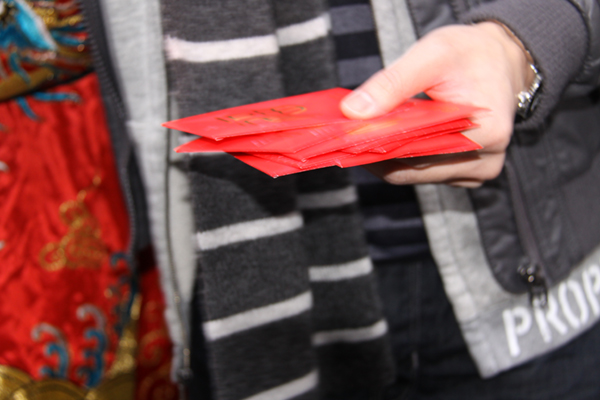
One of the jobs I came across was an invitation to write a blog post on how much money to give your girlfriend's parents for Chinese New Year. I have some experience of this. So I thought I would put myself to the test, see if I could bang it out in half an hour and then see if they accepted my offer - this is in reverse to the normal order of things but my main aim was to see if I could quickly write something suitable, at least on a subject I knew something about. This one at least didn't have to be particularly search engine optimised or contain links to manufacturers of red envelopes!

So, I wrote the post in about half an hour, which would have been viable. Sadly, the customer chose another offer, but, rather than waste it, here it is, a short piece for the uninitiated on how to play red envelope roulette.

How much money should you give your girlfriend's parents for Chinese New Year?

Chinese New Year is approaching for the first time since you got together with your girlfriend, or perhaps the first time since she made the big step of telling her parents about you – make no mistake, telling the parents about a suitor, particularly a foreign one, is a significant milestone in a relationship. Your girlfriend will of course be visiting her family, assuming she has already left home and you may even be accompanying her. Naturally, you want to make a good impression, aware of how important this is, particularly given your status as an outsider. And so the issue of hong bao (red envelopes) arises.

Initially, particularly if you have not been in China for long, you may have difficulty with the idea of giving envelopes stuffed full of money to family or friends. To your mind, gifts are more personal and hard cash seems rather mercenary – as if you’re saying exactly how much they’re worth. People do give money as a gift in the west but it is often in the form of tokens and more likely to be for children. Lets face it, a gift of money says to you “I really couldn’t think of what to get you and I didn’t want to risk getting it wrong”.

This is something you just have to get over! You are not going to single-handedly change Chinese culture and as you come to a deeper understanding of it, you will see that this practice is not so strange or mercenary. Bear in mind that giving money is not unheard of in European culture – for example pinning money to the bride’s dress in Italy. Nevertheless, you know you are going to be judged on how much you give and upon whether you get the figure right, avoiding inauspicious numbers. Get it right and you may well have smoothed the way to a fruitful relationship with those who may one day become your in-laws. And what goes around comes around – strong family relationships can be very helpful in Chinese society, particularly in terms of getting started out in married life and providing childcare.

Fortunately, you have one asset up your sleeve – your girlfriend. You love her. You trust her. She understands the culture. The simple answer is, you should let her decide. She knows best. Really. Talk to her about it, tell her how you feel about it and discuss what you can afford – there may be alternative figures depending on how much you have spare. But do not skimp. There really is no point and it will only get you into trouble. The likelihood is that you are well paid compared to most local people and even if you are short of money at the moment, as far as they’re concerned you should be well off. The fact is, this is more important than a couple of nights out with your mates as you enjoy ten days off work. You should listen to her while expecting her to listen to you too. And then do what you’re told.


Thursday, July 19, 2012

Still here, still there.

The recovering Taiwanoholic has not yet recovered.

I had a bit of a wobble today when I met some Taiwanese students at the language school I work at. After saying that I'd lived in their city for 9 years, then telling them that I used to live on Sanchong night market where the smell of stinky dofu filled the air every night, I found myself welling up and having to withdraw in order to maintain my teacherly dignity.

Recovery is an act in progress.

Wednesday, April 18, 2012

Lost and found in cyberspace.

I had a bit of a techno-nightmare last night. After spending several hours writing the previous post, I hit "Publish". Then, with an idea in my head, I set about starting another post - who knows whether it will materialise now. The previous post had been open in more than one tab in Firefox, in draft form. I closed the one in which I'd completed it and switched to the other tab, which was presumably no longer necessary. I cut the text from the input box leaving it apparently a pristine input page and started putting down some ideas. It was time for bed by this time, so with a few notes written, I hit save and returned to the front page to admire my work. The post that I'd seen only minutes previously had gone, replaced by my new notes. I was fairly pleased with my post and it had taken several hours over three days to write, it couldn't be repeated.

Frantically, I searched for some kind of archive on Blogger but found that my post had been erased from history. Not quite panicking yet, I thought "Google caches everything". There's no getting away from it, when you put something online it's there forever. My post had only been online for a couple of minutes though, so this would test that hypothesis.

I could remember the title and certain snippets of the text so I googled on or other of them. I must admit, I felt pretty pleased with myself when Google graciously threw up a hit. Great. Follow the link and I'll get a nice copy of the page from which to rebuild the original.

"The page you requested no longer exists"

"Shit!"

But it existed somewhere even though Google didn't seem to be offering me the option of a cached version. So I copied and pasted the end of the excerpt presented by the search engine into the search pane to see what I'd get. I got slightly more of the same sentence. I was encouraged. It must all be out there, but it was going to take time.

Slowly, bit by bit, I added different search terms and keywords, and bolted sentences and paragraphs together like a jigsaw puzzle. By running directly from one sentence to the next, within quotes, I could be sure that I'd got the order right and eventually I had what I think is the whole original text, possibly with one sentence missing. I'm sorry, you'll have to put up with that.

All in, it took me about two and a half hours to recover the 800 word document. Frustrating since it must all be out there somewhere in one piece, but my priority was to get it back quickly in case it could somehow disappear entirely, not to investigate further ways of working the web.

So, I worked for that post and didn't get to bed until 2.30am. But I exercised my problem solving brain to get it back which I have to admit I quite enjoyed. So read it, and hopefully appreciate it.

My journey, diverted.

Spring is well and truly here and it is good. It is my first real spring in 10 years. Nothing compares to an English spring, certainly nothing in the tropics where temperature variations are less extreme and the trees hold their leaves year round. The sight of bright green leaves fresh from their buds, unsullied by life's travails never fails to inspire me, as does ancient woodland carpeted with bluebells for a few short weeks in April and May. Visiting as I did in the summers, I had not seen daffodils or bluebells in ten years.

Spring is not the only thing that is here. Rosey is here now too. For the first three weeks she was here, the weather was consistently warm and sunny - with the occasional fog to be burnt off in the morning. So England chose to give her an unrealistic first impression. This has been put right since, at least as far as temperature is concerned, but there have still been few April showers. I hope the weather holds out and gives us a glorious summer, whatever the effect on the lawns and gardens of England.

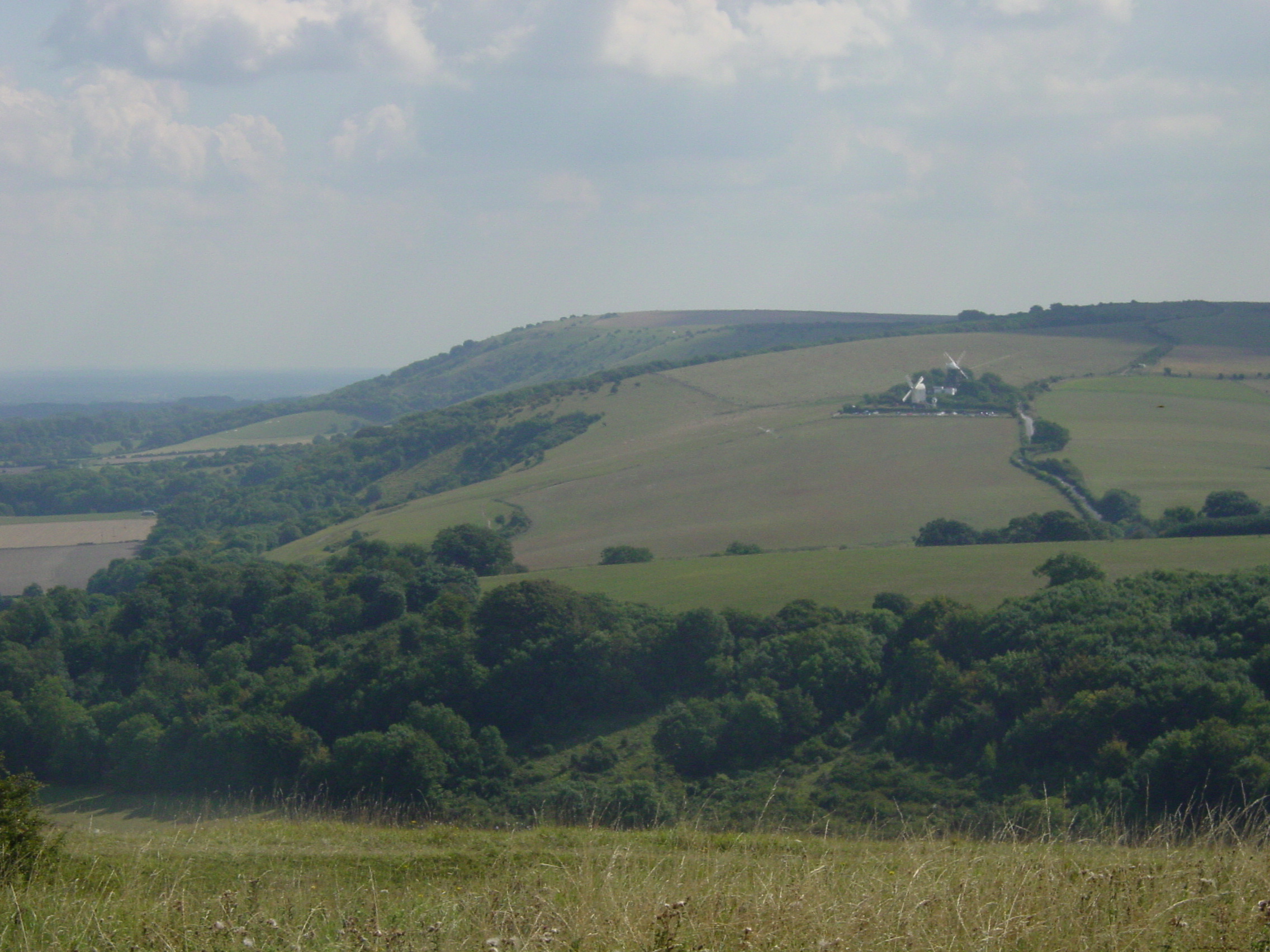
I cycled home from Shoreham today, taking the Old Shoreham Road around the back of Portslade and Hove to where Dyke Road intersects the bypass. There, I had the choice of whether to go down Mill Road and come straight home up the A23, or to take a longer route via Saddlescombe and Poynings. It's an area that has significant meaning for me, having spent a lot of my formative years building camps in the woods, drinking illicit beers and lighting fires on which we exploded full cans of WD40 (highly flammable aerosol lubricant) and second world war era machine gun bullets we'd found in The Dyke, which was then a military firing range. I occasionally return there, not just because of its personal meaning, but because it is an area of outstanding natural beauty with commanding views across the Weald of Sussex.

So, by the time I reached the junction the decision had already been made subconsciously, regardless of going through the motions. I was going the long route (neurological research suggests that the brain has made decisions before people are consciously aware of it). A few hundred metres later, I had the second decision of whether to ride to the top of the Dyke, or continue straight along the road leading through The Downs to Saddlescombe and Poynings on the far side. There was no going back at this point and I decided to ride on to the top, further diverting from the direct route home. It was a good day for it and when I reached the ridge from where the escarpment drops away to The Weald below, I was not disappointed by what John Constable described as "the grandest view in the world".

From this point, the sensible option for me on my touring bike would be to follow the road that returns to the through route. But I'd already set a precedent for being further distracted and I wasn't going to miss the opportunity to revisit the V shaped cleave in the Downs that is Devil's Dyke.

Devil's Dyke is said to be a trench dug by The Devil with the intention of drowning the God-fearing people of Sussex. God, in his wisdom, gave The Devil one night in which to dig his trench from the sea to The Weald. However an early rising old maid in Poynings lit a candle before dawn, fooling The Devil into thinking his time was up and sending him scuttling off to wherever it is he scuttles off to. So much for the fiendishly clever fallen angel.

In reality, Rick Santorum not withstanding, the Dyke was formed by a combination of thawing snow and running water over 10000 years ago and it is now the longest and deepest dry valley in the UK. More recently, the area around The Dyke has been the site of a funicular railway rising 100m from the village at its foot, a standard gauge railway from Brighton and a cable car crossing the valley.

After the first few metres, the middle of the valley is not enormously steep, but steep and bumpy enough to be riding constantly on my brakes. It would have been a lot of fun on a bike that was designed for that kind of thing.

It took another couple of diversions before I finally made my way home, including a visit to my grandfather's grave for what must be the first time in well over 10 years. It was hard to find the headstone in what is an unfamiliar graveyard and when I did, it was hard to make out the writing beneath the lichen that has colonised it. Life has moved in and moved on in the 25 years it has been there just as the natural processes made the Dyke over time. We return, less frequently over time, but still maintaining the link to our past.

Friday, February 17, 2012

Half way there.

Halfway through the CELTA and it is, as predicted, intensive. It is nice to be challenged, even if being either working or between working (meals, breaks, journeys, semi-productive time) from 7am to past midnight is not really my cup of tea. The people are nice, the group seems to get on well together - who knows whether every group does but I'm glad I've met them - and it's also nice to be working with people with a common aim or interest again.

It's 1am, I've just finished a lesson plan, and I'm getting up in 6 hours. Time for bed. Goodnight.

Wednesday, February 8, 2012

Getting on with it.

Three days into the CELTA and I'm still alive and less tired than yesterday. Not much time to write but I'll try to knock out one or two posts this month, if only for a little light relief!

Thursday, February 2, 2012

Preparing for the off...

I start a CELTA course next Monday. Having initially been cautious about whether the fact that this meant I was no longer looking for full time, permanent work starting ASAP, I'd been coy about letting the jobcentre know until it was all absolutely certain and paid for. It is their job to get you off benefit, not to get you into work - so despite the fact that the course is designed to increase my employability, I was worried they would say I was no longer fulfilling the requirement of being available for work in the run-up to the start of the course. They may have some discretion on this and fortunately, on the day I told them I got the "good cop". I was still available for temporary work so sanity prevailed. Hopefully, by the end of the course, Brighton's language schools will be beating a path to my door wishing to employ me.

I have to admit, I haven't been keeping very conventional hours for the past few months. Our household has always winded down quite late and when my parents go to bed, usually a little after 12, I tend to retreat to my bedroom and enjoy my own private downtime - reading, writing, surfing etc, sometimes not actually sleeping till 2am or later and waking up correspondingly late. With the full time course obligating more regular hours and taking better care of myself, it seemed like a good idea to get into training beforehand.

On Sunday, I went for a bike ride with the cyclist I met on the train the other week. I was a little hesitant to accept his invitation at first. Both my bikes were in bad shape and I was worried they would fail in a way not easily fixable at the side of the road. Of course, there aren't that many things that you can't put right well enough to get you home. I was making excuses. Sometimes you need a kick up the arse to remind you of what you're capable of. Thankfully, I made the right decision.

It wasn't only my bike that was in bad shape, however. I get around on my bike, riding to and from the station at both ends of all my journeys, but I hadn't been on a proper ride for some time. I soon discovered the difference between fit and nearly fit - resistance. It's one thing to be cycling alongside someone at a steady pace on the flat, but it is when you hit a resistance such as a headwind or a light to moderate hill and he carries on regardless leaving you falling behind that you notice the difference. To be fair, I was riding a fundamentally slower bike than his - heavier and with wider tyres - and also carrying my 6kg Kryptonite lock (after having one bike stolen, for the sake of peace of mind it's worth knowing that you've done all that you reasonably can to prevent theft).

We took a pleasant route under the South Downs via the villages of Poynings, Fulking and Edburton, to Shoreham and back to Brighton. We almost stopped at the idyllic Shepherd and Dog pub, nestled in a crook of the downs before deciding after only 7km it was too early for a a pint. Eventually, after around 40km we finished up at The Evening Star, a traditional pub in Brighton where I was introduced to several artisan ales and a couple of Chris's fellow real ale enthusiasts.

Having had my unfitness drawn to my attention, I decided it would be good to get into moderately good shape before starting the course next week, so along with my early nights I decided a little healthy exercise would set me in good stead. Each morning this week, I've been for a short ride (15km, 40 minutes) at around 9am and every day it has been a little easier. It feels good. To top it off, I visited a teacher training open evening at the Falmer campus of the University of Brighton. Falmer is on the outskirts of Brighton to the north east of the centre and, disregarding the bloody great hill in the way, only about two thirds of the distance I'd been cycling in the mornings. Ditchling Beacon is only 1km at an average gradient of about 9%, but it's not inconsiderable when you haven't been getting out much.

Once the thought had entered my mind, there was never really any doubt that I'd choose to cycle over taking the train. Once you reach the top of the hill, it's downhill all the way after all! So with an air temperature of 2 degrees, I set out as yet undecided how I would get home a couple of hours later and a few degrees colder. That said, I did fix a light to my handlebars immediately before leaving home, at a time when there was enough daylight left to get me there safely. So I guess that was never really in any doubt either.

So 40km again, a little tired but generally feeling pretty good. I just have to make sure I've recovered physically before next Monday.

Tomorrow I sign off. I hope the advisor is in a good mood.

Tuesday, January 31, 2012

Good news.

Rosey has her visa. I will be starting a CELTA (teaching English qualification) course next Monday, and in preparation I'm going to bed before 12, getting up before 8 and going for a 45 bike ride every morning. The last time I went to bed before 12 must have been many years ago. All very positive!

Rosey will still have to do another couple of weeks at work and then, she will be going to India for a further two weeks to do a yoga retreat in the first or second week of March. After 8 months, another 2 weeks won't hurt, particularly when she's coming halfway round the world to start a new life. A couple of weeks contemplation with as much time and space as she needs to herself will be no bad thing. And after all the trepidation regarding the long dark nights of the English winter, there'll barely be any difference in daylight between here and Taipei when she arrives, close to the equinox. It'll still be a little colder though.


Having just received the good news, there's not a lot more to say. It will take a little time to sink in but what I can say is that already it feels as if the future is open again.

Thursday, January 19, 2012

A walk, two windmills and three pints of ale.


I'm sitting on the close cropped turf of the South Downs, halfway down the escarpment with Jack and Jill Windmills above me and the village of Clayton just below. The windmills are grade 2 listed buildings dating from the mid 19th century, though Jill had a prior life in Brighton before she was towed by teams of oxen the 7 miles or so from there to the top of the Downs. They fell out of use in the first decade of the 20th century but were kept in good repair and appeared in the 1973 film, The Black Windmill featuring Michael Caine and Donald Pleasance. Jill, a wooden post mill, is now restored to working order and is open to the public in the summer, while Jack, a brick built tower mill, is a private home.

Clayton is a typical downland village of no more than around 200 people, built at the foot of the scarp slope where the clay of the Weald of Sussex meets the chalk of the Downs, providing a springline to irrigate the settlements. At the very base of the Downs is a Saxon church of simple design with a squat wooden belfry and steep roof. The Church of St John the Baptist at Clayton is mentioned in the Domesday Book and is a Grade 1 listed building partly due to its great age, but also because of the 12th century frescoes of the Last Judgement which adorn the interior walls and are unique in England.


I've been cooped up in the house for the past few days. It's good to finally get out, relieving my cabin fever and avoiding the otherwise inevitable irritability that would confront my family. As I sit cross legged on the hill with my laptop on my knees and sheep grazing around me, I wonder how this might appear to the passing hiker. Although the computer is now the universal tool of the writer, I can't quite imagine that I look like a modern day romantic poet, composing an ode to the landscape that lies before me. What then? Do I look like a workaholic unable to leave his work at home, let alone the office? Or just completely incongruous? Worse still, maybe no one's noticed me!

Rosey will be with me in about six weeks, assuming the visa goes through without a hitch. Her arrival can't come soon enough. My life has been characterised by distinct phases since coming of age and these have been mediated by periods of stagnation or consolidation as I try to work out the next move. So I have been living in limbo for the past six months. I've made some progress, but it has mostly been of a somewhat intangible nature, buried in my head and difficult to quantify. I have learnt about the areas I may go into without making solid progress into them. That is about to change, but that's another story.

I'd been surprised earlier to find a thick layer of ice in a water trough that lay in a shaded hollow. It hadn't seemed that cold to me as I walked up the hill in the mid afternoon but all that has changed now. The sun is setting beneath the brow of the hill behind me. I have maybe 20 minutes of daylight to play with, and two hours of battery life. The only place I can think of to spend it is at the 19th century coaching inn at the foot of the hill, with its selection of ales and roaring log fire (a cliché maybe, but a fine one). As the breeze begins to bite on my thighs and my necessarily unprotected fingers lose their accuracy upon the keyboard, it is becoming an increasingly attractive option. Time for the pub.

I reach Underhill Lane and must walk past the church to reach the pub. Isn't it traditional to visit both of these places on a Sunday? I like old places, so after pausing under the lychgate, I decide to go in. The path is paved with a rippled stone that was once the floor of a shallow sea. It always amazes me how transient features such as a muddy seabed are petrified, frozen in time. An earthquake suddenly raising the seabed before it is sun-baked before being covered by the sands of time, perhaps?

I have a little difficulty opening the heavy oak door but the cast iron latch eventually slots into place and I make my way into the now darkening church. Using my phone as a flashlight, I look around, imagining myself to look like a burglar until I find the light switches hidden in a wooden box on the wall. I turn them on, lighting up the chancel, nave and vestry in turn and bringing the ancient paintings, only rediscovered in the 20th century, into view. As I look around, I imagine seeing the ghost of a long dead clergyman crossing the chancel or passing through the wall into where a medieval chapel once stood. Nothing so dramatic for me so I mooch around, wondering if there are any rules about where it is appropriate for the hoi poloi to go. I decide the chancel with its benches for the choir is probably ok, but beyond the altar rail is probably best avoided. After reading the tourist information and history of the church, it is time to head to the pub.


A little later, I find myself (as if by accident?) warming up in the Jack and Jill Inn. A couple around my own age are having a Sunday evening meal and another, perhaps twice my age, have booked a room for the night. This is somewhere a stone's throw from home and it is initially difficult to imagine it as a holiday destination, but it is a welcoming place in the shadow of beautiful rolling hills. It is worth making the effort to appreciate the familiar. I would gladly now make my way up to a hotel room after a good meal and a few drinks. After two and a half pints of ale, my creative juices are beginning to flow, however the energy has almost entirely flowed out of my computer. It is time to finish my drink and make the trek home across the fields in the dark.
The sky is clear, and the air is cold. The stars are bright against the dark blue sky and I can see every breath clearly. The route home takes me down The Cinder Path, with the railway line to my left and dark woods to my right. For much of the way, I can see nothing, except by light of my phone. I am aware that when I was younger my imagination would have run riot in these circumstances, but I have an assuredness lacking in my early 20s. I am grateful for the cold. When I turn off the Cinder Path and cross the fields towards home, the ground that was muddy before is now frozen solid. A worthwhile trade.

When I set out from home six hours ago, I was frustrated, grumpy, unable to say much that was positive. This was not good, particularly since my sister had been visiting. I'd rather she didn't take away the impression that that was how I was at the moment (hi Sophie, hope you're reading). In short, I needed to get out, to do something and I felt much better for it. Exercise, countryside, history, culture and ale, washed down with the brightest stars I've seen in some time. Can't beat it. 

And as a postscript, Stephen Moffat's contemporary interpretation of Sherlock, enjoyed with my parents in the warmth of our living room with a cup of tea (I phoned my dad as I walked across the fields and said it was really cold and a cuppa cha would be very much appreciated). A good day (and three late nights to write it up!)

Saturday, January 14, 2012

The Presidential Election

As I write, the polls are opening in Taiwan's 5th popular elections for President.

I've belatedly been watching a few videos about the election including this one of the election eve rallies for CNN iReport and this one, a rap in Chinese subtitled "Keep Taiwan Free", which can only really be interpreted in one way regarding Taiwan-China relations and the respective positions of the political parties. Having said that, the lyrics in Chinese could be mean anything for all I know. I think I caught something about haircuts in amongst pictures of Tienanmen Square and crowds of activists turning out in all weathers dressed in disposable plastic raincoats and traditional rice farmers' hats.

The final rallies for the pro independence Democratic Progressive Party (DPP) and the pro China Chinese Nationalist Party (KMT) transform their respective areas of Taipei into a street party populated by people of all ages and walks of life. The energy and enthusiasm is palpable with a 75-80% turnout expected, and this in a country where most people retain their household registration (and thus vote) in their hometowns until they get married, leading to a mass migration on the night before the election. Some expats even fly back from the United States just to cast their ballots or take part in the campaign. Given the voter registration system mentioned above, the tribal nature of Taiwanese politics and the authority held by the senior family member, it is also a good opportunity for overseas Taiwanese to catch up with their extended families.

Seeing Taiwanese people demonstrating such passion for their respective causes, albeit in a political environment with tribal undercurrents and dominated by a single political issue, makes me want to be there among them more than ever. Elections in Taiwan, at least some of the time, have an innocence missing in the west. With 1500 Chinese missiles pointed at Taiwan, an economy increasingly intertwined with China's and few diplomatic allies, the issues at stake could not be more serious. However, there is an endearing quality to Taiwanese election campaigning, in part due to the Japanese influenced ke-ai (cute) culture as demonstrated in fluffy dolls or cartoon representations of contemporary and past leaders (Mao, Chiang Kai-Shek, Sun Yat-Sen). What could be more adorable than a figurine of a psychopath responsible for the death of 70 million people?

That's not to say there are not fist fights in the legislature or outbreaks of hysteria in the street. But this is because politics matters in Taiwan. Taiwanese people do believe in their causes, even if making money takes precedence over lofty ideals in their day to day lives. The way that politicians demonstrate their dedication to their cause is to fight for it, just as the way a doctor demonstrates his competence is by prescribing multiple drugs.

During what was the longest period of martial law in modern history (1949 to 1987), opposition and independence activists were imprisoned by the KMT government, including some members of the previous generation of leaders of the DPP. The former President Chen Shui-Bian was among those imprisoned in the 1980s and he is in jail again now, convicted of corruption.While it is likely there is an element of truth in the charge of embezzlement  (as much as for any Taiwanese politician and perhaps no more than he could reasonably expect to be considered normal in that culture), his conviction and the length of his sentence are widely believed to be politically motivated under pressure from Beijing.

So, politics matters in Taiwan. Despite the apparently superficial lives of many young Taiwanese who are blissfully unaware of how hard won their freedoms were, despite the preoccupation with making money, despite the absence of any great differences in socio-economic ideology between the technically liberal/social democratic DPP and slightly more conservative (though in its early days in China, socialist) KMT, and despite the sometimes juvenile appearance of its discourse, there is optimism to be found in the politics of Taiwan, one of the freest countries in Asia and the only example of a culturally Chinese democracy. So long as the election is clean, I wish its winner well, on the one proviso that they do not sell out the people who elected them either by directly negotiating unification with China without consulting the people, or by engineering the economy such that in the long term there is no realistic choice.

Tuesday, January 10, 2012

How I arrived in Taiwan

With 20 minutes to go, I was getting a little nervous. Having recently cycled from the UK to Singapore, I was full of confidence and had jumped onto a plane at Bangkok without so much as thinking about getting a visa for my destination, Taiwan. The worst they could do was turn me round and send me back and with no money, I reasoned it couldn't be at my expense. Being unprepared couldn't possibly be advantageous, but I didn't care.

As the plane docked, the adrenalin was flowing through my veins. I was enjoying it, not exactly daredevil stuff, but not knowing what would happen made things more interesting. I took my time getting my things together. I never saw the point in standing up for five minutes waiting for the doors to be opened and then for the people in front of you to disembark. Far better to relax and then walk to the front of the aircraft at a comfortable pace. When the crowd thinned, I got my bags together and found a stray package under the seat in front of me. This was less than a year after 9-11 and we all know what we're supposed to do with unattended luggage. The occupant, along with almost everyone else, was long gone. It was a carrier bag with what appeared to be a box of 200 duty free Marlboro cigarettes. Nothing personal or really valuable that I would feel compelled to find the owner of. Theoretically, it could be a bomb, or even elaborately packaged contraband, I supposed. The rule book says play it safe. Sod it, I thought. If they are cigarettes, they're well within the duty free limit and I can sell them in Taipei, although I had no idea what they were worth before or after duty. If I get blown up, I probably won't know much about it. And if it's something else, we'll cross that bridge when we come to it.

I made my way to passport control, hoping that a. they let me in, b. I didn't get blown up and c. I wasn't an unsuspecting drugs mule. "May I see your passport please, sir?"

"Here you are," I replied, unaware if I even needed a visa.

"Do you have a visa for The Republic of China, sir?" I was just about well informed enough to know that The Republic of China referred to Taiwan, not China.


"No. Do I need one?"

"How long are you planning to stay?"

"...er, I'm not sure. Maybe two or three months."

"And what do you intend to do in The Republic of China?"

"I thought I might teach English," I replied casually.

"I can give you a one week landing visa. If you want to stay longer than that, you will have to leave the country and apply for a visa at one of our overseas missions."

That was better than being turned round and put on a plane immediately, so I was happy. I could find a place to stay, work out what I was doing in Taiwan and then spend more money that I didn't have on a weekend trip to Bangkok. It could be worse. Thus began my totally unplanned 9 years in Taiwan.

Convenience is a watchword in Taiwan. I collected my bags and my bike, walked through arrivals hoping my duty free didn't set off any alarms, glanced around and then walked the few metres to the ticket office for the buses that waited just outside.

"Where would you like to go, sir?" the attractive young lady asked.

"Taipei?" I said tentatively.

"And where would you like to get off?" she continued.

"I'm not sure, I replied. "I need a cheap hotel."

"Taipei Main Station is the best. The driver will tell you when to get off."

I paid the money, thanked her - as yet unable to do it in anything other than English, picked up a few tourist leaflets and stepped through the automatic doors. The tropical heat hit me hard in the face. I breathed deeply and felt the warm, moist air filling my lungs, a stark contrast to the cold, dry air inside the terminal building.

It was immediately clear which bus to get on. The driver checked my ticket, helped me place my still boxed bike in the luggage compartment and I boarded the bus.

I sat on my own, about three quarters of the way down the bus and began to glean what I could from the tourist literature I had picked up. As I was reading, I noticed a girl in her late twenties or early thirties sitting on the opposite side of the bus.  With everything to learn, I tried to appear approachable, while not making any particular effort to strike up a conversation.

It wasn't long before she took the lead. "You're new here, aren't you?" Clearly she was not.

"Yes," I replied. "I've just arrived from Thailand." Then, as now, I didn't want the story of my cycling expedition to immediately dominate the conversation. She gave me her card and recommended that I get one made as soon as possible after getting a phone. She told me that I should be able to find work quite easily and that the website tealit.com was a good place to start for most expat things in Taiwan. When the time came to disembark, she said to stay in touch, and wished me luck with my adventures.

It was a few days later when she emailed me to let me know that a room had come up in her rooftop apartment for one month, while its English occupant went for a boozy month watching the world cup in Bangkok. I accepted the offer and moved in within days, making friends that I'd know for all of my time in Taiwan and the Englishman, back in the UK too. It was only later that I discovered that she'd described me to them as "kinda green, fresh off the boat". Having passed through approximately 20 countries en route, I wasn't too bothered!

Monday, January 9, 2012

A good day.

Today was a good day.

I woke up at around 10 and listened to Excess Baggage, a travel programme on Radio 4. One of the guests was a veteran woman adventurer who'd travelled south and east Asia solo in the 1950s. I imagined her to be a spirited woman who'd be great fun to have as a grandmother. Following this, as I lazed in bed, was Reasons to be Cheerful, a light hearted exploration of grumpiness and happiness which included a brief foray into karaoke, invented by the Japanese but very popular across Asia , including Taiwan where it is known as KTV.

Having had fond memories of drunken exploits in the 10 storey KTV palaces common in Taiwan awoken, I ventured downstairs to eat breakfast. My dad was opening the mail at the kitchen table as I made the essential morning litre of tea. I made myself comfortable with a good mug of strong tea, a bowl of cereal and a section of The Guardian. My dad opened an envelope which contained a card and three sub envelopes addressed to my brother, sister and myself. The package was from the my late 'Aunty' Iris' niece, who'd been responsible for her estate. It contained a sum of money part of which was a  legacy specified in the will and part of which was at the discretion of Iris' niece in generous recognition of the fact the original sum had been determined some time ago. The precise amount is irrelevant, though it is enough to be both useful and memorable. The entirely discretionary excess from the executor was very kind. I look forward to setting up home with Rosey and choosing something useful and lasting to remember Iris by.

I wanted to get the money into my savings account as soon as possible, not out of any desire to spend it but because it made it somehow more tangible. A bank balance on a computer screen is no more real than a cheque, both represent potential, but I wanted to get on with it rather than reading the card, acknowledging it and going back to my breakfast. Getting on my bike immediately, racing to catch the next train to Brighton and paying it into The Cooperative Bank (ethical investments n.b.) before they closed at 1pm felt like due recognition of the gift.

I dashed to the station, lined up at the ticket machine behind a gaggle of school children and bought my ticket with just enough time to board the train. On reaching Brighton at 12.47, I raced the half a mile to the bank and made with a five minutes to spare, paying the cheque in immediately before the bank closed.

I had another task in Brighton too. My parents had offered to get my bike serviced for Christmas so I needed to get a quote. Strangely, it had originally been my Taiwanese bike that we thought needed the serious work but on closer examination all it needed was a once over that was well within my capabilities. My Scott racer however, had been sitting unloved (or loved from afar) in the garage for 10 years and needed all of the regular replacement parts and adjustments such as brake blocks and cables, and some more infrequent ones too, such as a whole new drivetrain - chain, cassette (cogs) and chainwheels. This was turning into a significant job, likely to be beyond the budget of a Christmas present.

My first port of call was Evans cycles. I spoke to a young man who gave me his opinion. The basic service would include the usuals - blocks, cables, housings etc and the wear on the drivechain was very obvious. He looked at the wheels, said the rims were dangerously worn and that all in, I could spend £300 to get the bike into perfect working order but I'd make better use of my money replacing the bike. He went on to say that to get a similar spec on a new bike would cost £700! How spending twice the money and scrapping a bike worked out as better value, I'm not sure.

There's a variety of bike shops in Brighton and I decided it would be as well to get a variety of opinions. The next shop gave a slightly better quote but also recommended replacement because the parts for my 12 year old machine were increasingly difficult to come by.

I moved on to three more bike shops, and each of them were scathing about the first two saying my bike was basically a good bike, even with a reasonable resale value, and that the parts were still available. They didn't reckon the wheels needed replacing but we were still looking at £150-£200 including parts and labour. Not cheap, but all machines require maintenance, even to the extent that you'll eventually spend more on that than the original price.

As I left Sydney Street Bikes, I heard a distinctive voice talking to his girlfriend about the bikes on display in the street. Not only was his voice vaguely familiar but when I took a second glance, his appearance seemed familiar too. Combined with the fact that he was talking about bikes, I thought to myself, "Is that Samer?"  Samer is a friend of a friend from London, a keen cyclist who managed to inspire the most unlikely of my social group to take up cycling. I've met Samer two or three times and this guy seemed unnervingly close but at the same time, not quite as I remembered. Just as he was walking away, I thought, "No harm in asking..."

"Samer...?" I called out. He turned around and said yes, clearly unaware who I was. "I'm Mark's mate, Toby," I said, confident that a fellow cyclist would remember me and my adventures traversing the globe in the saddle.

"Which Mark?" he asked.

"Mark Russell, didn't you live with him?" I said, a little perplexed.

"That's my brother," he replied, "I'm called Saamah too!"

"I thought you looked a little different," I said. He was pleased, explaining that there was seven years between them. We chatted for a minute or so and then, with little more to say, went our own ways, uplifted by an agreeable coincidence and congenial human interaction.

I had another reason to visit the bike shops as well. Hassocks Community Cycle Hire is looking to form a business partnership for the coming season, giving it access to highly skilled mechanics to carry out the full range of services. It was delegated to me to test the waters with shops that could be interested. There was enough interest in the shops I visited to merit putting together a more formal proposal, which we will be doing shortly. In one of the shops, I met an employee who was very enthusiastic about the project on a personal level and seemed like a good person to stay in contact with, regardless of whether he would be an actual business partner.

With the wind in my sails, I rode up to the station and caught a train that was leaving within a couple of minutes. With no time to spare, I got on at the first vestibule, where I found another bike propped up against the opposite door. I had no option but to stay with my bike at least until the train set off and with few free seats and only a ten minute journey there was little point in sitting down. I looked the other bike up and down, as cyclists are wont to do and glancing down the carriage saw my action had flushed out its owner, who was sitting further down the carriage clearly aware his bike was being given the eye. It was a nice bike with traditional road touring geometry. Aware of each other but with no reason to break the ice we carried on as before.

It was only when his bike fell over that he had reason to come and talk to me. "Nice bike," I said and he returned the complement. We got chatting and I explained that mine was a nice bike, but it needed a lot of work and that I'd got some quite different opinions and quotes from different shops. He was unsurprised, particularly about the chain store (sorry, no pun intended). We made the usual small talk and over the course of the journey I discovered that he did a bit of touring himself, appeared to be a similar age to myself and knew what he was talking about. I was just beginning to regret that I had to get off at the next stop, before I'd had time to establish how far away he lived and whether it might be worth staying in touch. Perhaps he was thinking the same and as the train decelerated into Hassocks, he gathered his things together and made ready to get off. "Oh, er, are you getting off at Hassocks, too?" I asked. It turned out that he, like me, having been far and wide was now living with parents in Hassocks in his mid 30s and I got the impression that he was probably as glad to bump into me as I was him. He lived in the centre of the village and we rode down, chatted for a short while and arranged to ride to Lewes and have a few pints mid week.

I arrived home invigorated, having established that my racing bike would soon be in top condition, paintwork notwithstanding, made progress with a worthwhile community project, and through fortuitous timing having been in just the right place at the right time to have several heartening human interactions.

To top it all, I went for a quick spin on my other bike, establishing that it was indeed in good working order and then returned home made up with a friend who I'd carelessly managed to offend online the day before. The lesson, doing things, being physically active and interacting with people makes you feel good.

Friday, December 30, 2011

How to do Christmas

Christmas is over.

I can't say I'm not glad. It was something of a disjointed experience that lacked energy from the start. On several occasions and in general I didn't quite know what to do with myself, as if Christmas were a skill that I'd lost! I didn't know what presents to buy people, particularly those who I'm less close to. Latterly, from being on the other end of the deal, I've discovered that what one does is buy chocolates. With no particular relevance to any individual, how meaningful giving chocolates is, is up for debate but they always go down well, as did my home made mince pies which I gave to a couple of people.

Greater spending power would have made it easier to get enthusiastic about buying presents. It's the thought that counts, but money widens the selection and festivities are all about larging it up. Christmas is no time to be poor - not because money is important in itself, but because participation is important and this often costs money.

As well as larging it up, Christmas is about family. It was always going to be a tough nut to crack this year. I'd been away for 10 years so my mum's expectations of a family reunited would be high and my own memories of what Christmas should be would be hard to live up to. Christmas being about family only serves to underline their absence when they're not there, but I was not alone in being alone, my brother and sister both having recently gone through break ups. I could at least talk to Rosey on Christmas day.

My dad has been ill and is still lacking energy due to the TIA he suffered in October. On top of this, his twin brother has a heart condition that is at very least slowing him down a little. They have a history of doing things together! In light of this, the biennial boxing day trip to his house near Guildford seemed particularly low key. With his children long since flown the nest and having their own in-laws to visit on the second day of Christmas, it was just my uncle and aunt, an old family friend and the five of us (I have one brother and one sister). In the good old days when Christmas trees were twice my height and the holidays went on forever, there must have been at least 15 people around the twin tables of Guildford and Brighton. There are as yet no young ones to fill the spaces round the table, leaving my parents in the position of having reached seniority without managing to pass the baton on!

My great aunt, Aunty Nancy made it down from Tamworth, after an initial wobble. Not having seen her for two years, I like to think I had something to do with changing her mind! She was prevented from coming last year by the dramatic icy weather - she can manage long car journeys but at her age the possibility of being stuck on a frozen motorway miles from service stations, as many were, did not sound prudent. Fortunately, the weather was more mundane this year. It's a good thing we changed her mind. They say when you fall off your bicycle, you should get straight back on. Once you give something up, it's hard to start again (except cigarettes).

Aunty Nancy has been old since I was young, though she was never a very old old and back then she was younger than my parents are now. Old people are younger than they used to be as they get old older. She is now a fairly young 90, still living in her own home on two floors. She even still owns a 1970s mini and has driven it within the last year - though this is not to be encouraged. Where she fitted in to the generational mix was always slightly ambiguous due to being born half way between my mum's siblings and her brother, my grandfather but to think that I once considered 65 to be old seems remarkable. Good job if we're all going to be working until we're 70. My parents, hovering around 70, are verging on being elderly but I see them as just a little greyer than before.

So Christmas this year has been a reminder of several things. You have to make an effort. It is about participation and this is a two way street. It is not a good time for those who are excluded (I am not referring to myself here, but I can perhaps empathise a little with those with more serious problems). It has a lot to do with generations and like it or not, my parents and their siblings are now the senior generation with all the considerations that entails, though in my immediate family there is as yet not patter of tiny feet to rebalance the family. Where will Rosey and I fit into this as the first to get married, hopefully in some sense settle down and perhaps build a household with children?

Onwards to the New Year and another milestone, my parents' Ruby wedding anniversary (40 years) on New Year's Day.

Thursday, December 29, 2011

Nought shall come of the noughties

On Saturday night while my parents were at a Christmas party, I had a quiet night in with the remote control. Things weren't actually so bad and having waded through the listings I found Catherine Tate's Laughing at the Noughties, the story of comedy in the first decade of the 21st century told through interviews, talking heads, her own scripted monologue and original clips.

I was familiar with much of it. It would be hard not to have noticed The Office or Borat. I used to download quite a lot of TV in Taiwan and there was also a multimedia on demand service which carried quite a lot of British dramas, comedies and even documentaries. I managed to keep in touch to some extent but the show underlined just how much of our shared culture comes through the telly, even in the age of the internet. I'd missed out on programmes that reflected and contributed to the zeitgeist and marked the rise of those comedians who are now the mainstream, making me immune to cultural references and appear even more square than I really am! Now I know how parents of teenagers feel.

It was nice to be able to put names and back stories to the faces I'm getting used to in the media and to weave them into the cultural tapestry that I'm not yet fully embedded in....


As if to underline how much popular culture means to your conception of an era, two weeks later I've just watched Ben Elton's Laughing at the Eighties. Now that's what I call a decade!

Sunday, December 18, 2011

Christmas shopping

I went Christmas shopping the other day. Christmas window shopping, to be more accurate. I walked around the North Laine area of Brighton, a slightly trendy cum alternative area of mostly small independent shops and cafes with a few pubs and venues thrown in for good measure. The shops are mostly in narrow streets of two or three storey Victorian terraces and for me typifies what is good about commercial Brighton.

Walking round, surrounded by others trying to get their shopping done on a week day, I felt somehow excluded. Of course, having very little money in a commercial area at a particularly commercial time of year does that to you at the best of times, but I wasn't sure I knew what to do, or if I wanted to join in.

I tried hard. I walked around many different shops - bookshops, clothes shops, junk and curios shops and a flea market. I increasingly felt that, unless your relatives either had an active interest in collecting something or had a clear need for something, all you are doing is buying more stuff to fill up their lives, that hopefully they'll like. I don't mind doing this for kids - they continuously need eclectic new things to build their characters around and the input of older generations is a good thing, but for adults it feels a bit forced.

The only alternative to buying something they actively needed or wanted, was to walk around and hope that something cool jumped out at me. Junk shops are good for that - for the unexpected. I looked around a couple, finding old nicknacks, brassware, toys and household goods from decades past. But nothing really interesting suggested itself to me. In Snoopers Paradise, I rifled through boxes of photos and postcard of up to 100 years old, presumably retrieved from house clearances. I hoped to find an image of something that would have some meaning to me or someone I knew. Unfortunately, the closest I found was a postcard sent from the next village to my own around 80 years ago. I bought it for 30p.

Having failed to find anything, I will be forced to go shopping again next week. Something I genuinely want to give people usually turns up. It's just that like this career thing, it takes a little time to crystallize in my mind.

Thursday, December 15, 2011

Early indications....

It's amazing how things seem obvious after the event. Birds are descended from two legged dinosaurs; computing technology (information processing) would converge with communications and media in universal technologies like the iPad;  the girl you "liked" as a teenager actually liked you in just the same way.

I was passing the Churchill Square shopping centre in Brighton on Tuesday. It was a brisk winter's day and both inside and outside were packed with shoppers preparing for Christmas. Seeing WHSmiths at the end of a row of shops took me back to when I was about 7 years old, spending my gift tokens in that same shop in the days between Christmas and New Year.

WHSmiths is something between a newsagent, stationary store and a bookshop - a good choice when giving school kids tokens. When I went to spend mine, I found a Petite kids typewriter, almost exactly like the one below (isn't Google wonderful - I couldn't even remember the name, let alone what it looked like earlier today). I probably bought it because my dad had a grown-ups' typewriter and it looked like fun though whether he thought so when typing up lecture notes, correspondence and reports I don't know. I scraped together all my Christmas money and bought the typewriter. It was not a precision engineered machine, but it worked for a while and gave me some pleasure, albeit at the expense of ink stains on clothes and carpets.


There were other pointers too, like writing a couple of half decent poems, a few stories and keeping diaries when I was around that age. My mum was certainly proud of them - though that is obviously not a very convincing argument in itself!

Perhaps the trouble was that writing seemed like such a normal skill that unless you were going to write novels or be a journalist, how could you use it to make money? It's only now that I realise that behind every well written website, brochure or advert is someone whose speciality is words. And there are many poorly written websites sorely in need of such people.

I can do that. Seems obvious?